The decision to build AI in-house or work with an external partner is one of the most consequential early choices in any AI program. Both models work. Both have real costs that are frequently underestimated. The decision depends less on ideology and more on what your organization actually needs to accomplish in the next 12 months and what talent and infrastructure you have in place today.
This comparison covers the real US cost of in-house AI, what a dedicated engineering pod provides, and the conditions under which each model produces better outcomes.
The Real Cost of In-House AI in the US
US salaries for AI engineers are among the highest in the world. A senior ML engineer in a major US market (San Francisco, New York, Seattle, Austin) commands $200,000 to $280,000 in total compensation including base, equity, and benefits. AI architects and principal engineers go higher. These are not outlier numbers; they reflect 2026 market rates from public salary data at large technology companies and well-funded startups.
Recruiting timelines compound the cost. A typical US engineering hire takes 3 to 5 months from job posting to start date when you account for sourcing, screening, interviews, offer negotiation, and notice period. For specialized AI roles with a thin talent pool, 6 to 9 months is not unusual. During that time, your initiative either waits or progresses with inadequate staffing.
- Senior ML engineer (US): $200,000 to $280,000 total comp
- AI architect (US): $250,000 to $380,000 total comp
- Data engineer with AI experience (US): $160,000 to $220,000 total comp
- Average hiring timeline for AI roles: 3 to 9 months
- Ramp to full productivity for a new hire: 2 to 4 months after start
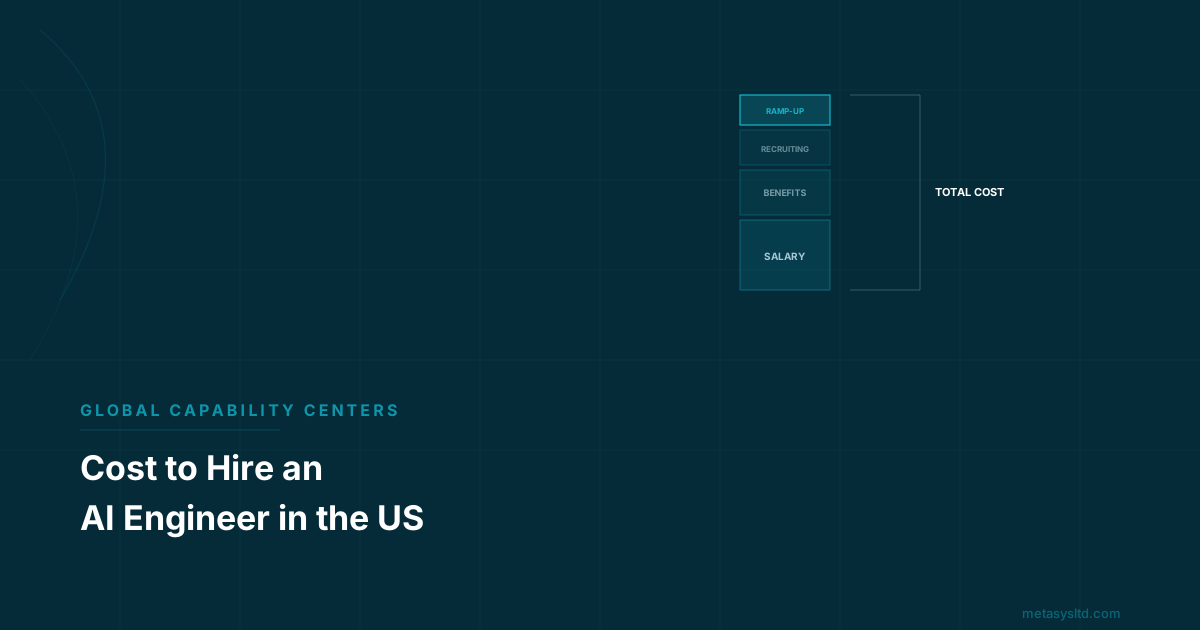
The total cost to get a single senior AI engineer to full productivity from the decision to hire is frequently $300,000 to $450,000 in the first year when you include salary, benefits, equity, recruiting fees, and the productivity ramp. This is not an argument against hiring. It is an argument for understanding the real cost before deciding which model to use.
What a Dedicated Offshore Pod Provides
A dedicated engineering pod through a partner like MetaSys provides pre-vetted AI engineers who are already familiar with production agent architectures, evaluation frameworks, and managed operations patterns. The ramp time from decision to first production build is measured in weeks, not months.
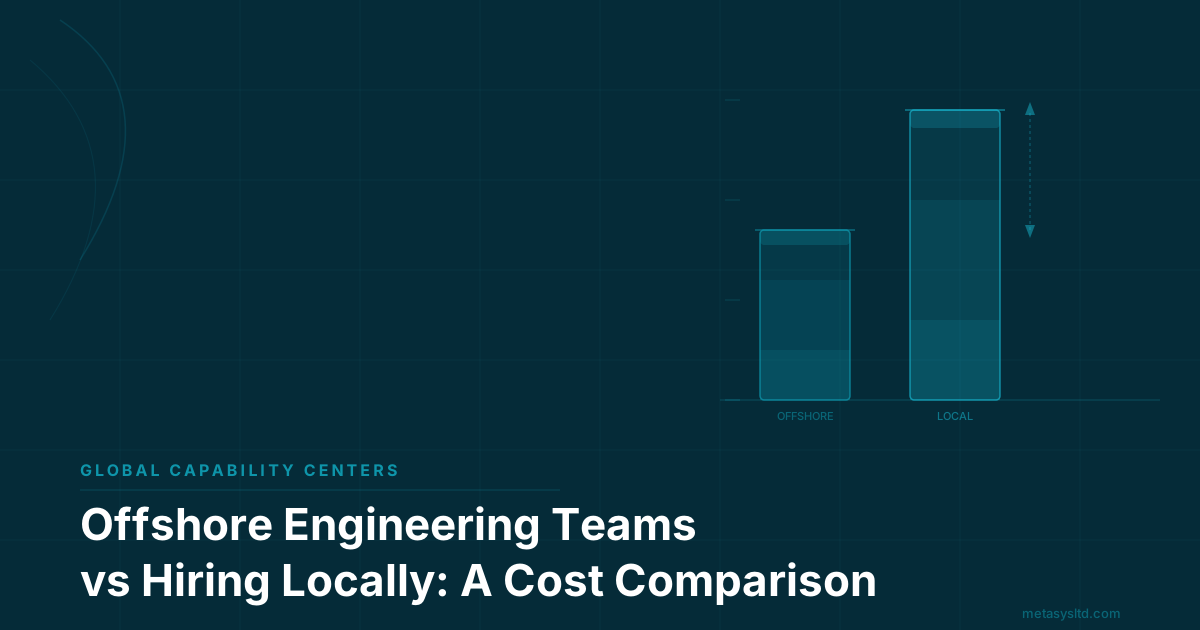
The cost structure is fundamentally different. A dedicated pod with a tech lead, two senior engineers, and a QA specialist runs $25,000 to $45,000 per month fully loaded, depending on seniority mix. That is equivalent to one mid-level US AI engineer in total compensation. The pod delivers more capacity and a broader skill set.
Speed to production is the most underappreciated advantage. MetaSys reaches a first production agent in approximately two weeks from engagement start. That is not a prototype. It is a working system in a production environment, handling real inputs, with evaluation running and observability in place. Our hire AI engineers page covers the pod model and engagement options in detail.
US Time-Zone Overlap and Collaboration
The most common objection to offshore AI development is communication friction. It is a legitimate concern when the vendor operates on schedules with no synchronous overlap. MetaSys is headquartered in Fulshear, Texas with engineering teams in the UK and Pakistan that maintain scheduled US-hours overlap. Project leadership communicates in US Eastern and Central time. Same-day response on production issues is a standard commitment, not a premium add-on.
The combination of US-anchored leadership and offshore engineering is the model that produces the best economics without the collaboration friction of a purely offshore arrangement. You get the cost structure of an offshore team with the communication patterns of a US-based partner. Visit our Global Capability Centers page to understand how the model is structured.
When In-House Makes More Sense
In-house AI makes sense when the problem is genuinely novel, requires deep domain expertise that cannot be transferred efficiently to an external team, or is central enough to your competitive differentiation that you want full organizational ownership and institutional knowledge retained internally.
Companies that have already hired strong AI leadership and want to build a proprietary capability are often better served by augmenting that in-house team than by replacing it. In these cases, a dedicated pod can accelerate the in-house team rather than substitute for it: taking on defined build work while the internal team focuses on the highest-value architectural decisions.
When Outsourcing Makes More Sense
Outsourcing AI development makes sense when you need production capability in a time frame that precludes building a team from scratch, when the problem is well-defined enough to specify to an external team, or when the total cost of hiring, onboarding, and managing an in-house team exceeds the value of the capability you are building.
The decision is not permanent. Many organizations that start with an external pod internalize the capability once the patterns are established, the evaluation infrastructure is built, and they understand what they actually need to hire for. Starting with an external team that documents its methods thoroughly makes the eventual internalization significantly cheaper and faster. Book a conversation to compare the models for your specific situation.