Sit through three vendor demos in one week and you will hear "AI agent," "AI assistant," and "chatbot" used to describe the same underlying product, sometimes by the same salesperson in the same sentence. That is not a vocabulary problem. It is a scoping problem waiting to happen, because the three terms describe genuinely different levels of autonomy, and buying the wrong one means either overpaying for capability you do not need or discovering mid-build that the thing you bought cannot do what you assumed.
Here is what actually separates them, with one concrete example each, and a way to test which one a vendor is really pitching you before you get on a scoping call.
Chatbot: a scripted or retrieval based conversation, no autonomy
A chatbot answers questions. It does not do anything beyond that. Most run on one of two engines: a decision tree of pre-written responses triggered by keywords, or a retrieval system that searches a knowledge base and returns the closest matching answer. Either way, the chatbot has no goal of its own, takes no action outside the conversation, and cannot chain steps together. Ask it something outside its script or its indexed documents and it either fails gracefully or fails badly.
Example:a support chatbot on a pricing page that answers "what is your refund window" and "do you offer annual billing" by matching the question to an FAQ entry and returning the stored answer. It cannot process an actual refund, check a specific customer's account, or escalate on its own. If the question does not match anything in its knowledge base, it says so and, at best, offers a link to a human.
AI assistant: does what you ask, one step at a time
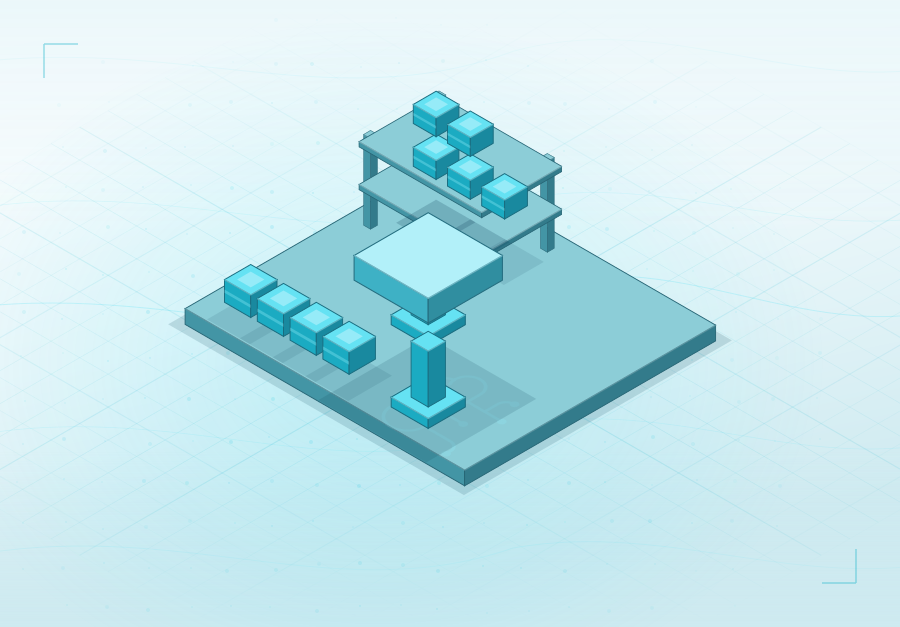
An assistant is bounded by your explicit instruction. You ask it to do something, it does that one thing, and it stops and waits for the next instruction. It can use language understanding to interpret an ambiguous request and can often complete a task that would take a chatbot's rigid script apart, but it is not pursuing a goal of its own and it is not deciding what to do next. The user stays in the loop for every step, not just the exceptions.
Example:you ask an assistant to draft a follow-up email to a client based on notes from a call. It writes the draft. It does not decide on its own to also check the client's invoice status, does not send the email, and does not follow up next week if you do not ask it to. Each new task is a new, separate request.
AI agent: pursues a goal across multiple steps, on its own
An agent is given a goal, not a single instruction, and it plans its own sequence of steps to get there. It calls the tools it needs, an API, a database, a document store, observes what each step returns, and adjusts the plan if a step fails or produces something unexpected. It keeps going without a human re-prompting it at every stage. The only points where a person gets involved are the checkpoints the system was explicitly designed to stop at, commonly called human-in-the-loop gates, not every intermediate action.
Example:an agent given the goal "reconcile this month's vendor invoices against purchase orders." It pulls invoices from the accounting system, matches each one against the corresponding purchase order, flags line-item mismatches, requests a missing document from a vendor portal when one is short, and closes out every invoice that matches cleanly without asking a human to confirm each match. It only surfaces the exceptions, a duplicate invoice, a price that does not match the PO, to a finance controller for a decision. That is the structural difference from an assistant: the agent decided on its own which invoices needed a human and which did not.
Where the human actually sits in each one
The clearest way to see the difference is to ask where a person's attention is required:
- Chatbot: a person is on the other end of every single exchange. There is no autonomous action to review because none is taken.
- Assistant: a person initiates every task and reviews every output before anything downstream happens. Nothing moves without a new prompt.
- Agent: a person is only pulled in at defined checkpoints, or when the system hits an exception it was built to escalate rather than guess at. The rest of the sequence runs without a person re-approving each step.
This is also why an agent is the hardest of the three to build correctly. A well-scoped agentic AI system needs those human checkpoints calibrated deliberately: too many and it behaves like an assistant with extra steps, too few and errors compound before anyone notices.
Why "agentic" shows up in almost every vendor pitch now
"Agentic" is the label buyers currently associate with the most advanced, most valuable category, so it gets attached to products that have not changed their underlying architecture, only their marketing copy. A chatbot with a large language model swapped in for its old decision tree is still a chatbot if it cannot plan a multi-step sequence or act without a prompt for each step. The industry has started calling this practice "agent-washing," and it is worth treating as a real risk rather than a cynical exaggeration, because the gap between a demo and a working production agent is exactly where most of the actual engineering effort lives.
Three questions cut through most of it on a scoping call:
- "Walk me through what happens after I give it the goal."If every answer starts with "then it asks you," you are looking at an assistant, not an agent.
- "What happens when a step fails or returns something unexpected?" An agent has a defined answer: retry, replan, or escalate. A chatbot or assistant usually just stops.
- "Where exactly does a human have to step in, and why there?"If the honest answer is "everywhere," the checkpoints are not real design decisions, they are the entire product.
Which one actually solves your problem
The right tool depends on what you are actually trying to fix, not on which label sounds most impressive in a board deck:
- If the problem is answering the same handful of questions over and over, a chatbot is the correct, cheaper, and easier to maintain answer. Building an agent for this is expensive over-engineering.
- If the problem is speeding up individual tasks that a person still wants to review and trigger themselves, an assistant fits. It removes the manual work of doing the task, not the decision of when to do it.
- If the problem is an end-to-end process with real volume, where most cases follow a predictable pattern and only a minority need judgment, an agent is worth the additional build effort, because that is exactly the shape of work an agent removes from a human queue.
Getting this classification right before a build starts is a scoping exercise, not a technology choice made after the fact. Our AI consulting engagements start there deliberately, and our AI agent development work only proceeds once a process has been confirmed to actually need agent-level autonomy rather than a cheaper assistant or chatbot.
If you are heading into a scoping call and are not sure which of the three you actually need, talk to an AI architect before you commit to a build. The classification takes minutes to work through properly and determines almost everything about cost, timeline, and what "done" looks like.